| Statement:
While researching molecular music, I came
to discover that molecular music was the apex of the postmodern
movement: it was an art that had no artistic value itself, but stood
only to represent a greater idea. Unlike other postmodern art, molecular
music does care to evoke passion, but rather stand as a means to
experience our DNA on a new level. Instead of traditional molecular
music, I wanted to incorporate passion into the music as a means
to impress upon the listener certain ideals and provoke the audience
to think about questions essential to our changing society in relation
to biotechnology – much like the aims of other postmodern
art.
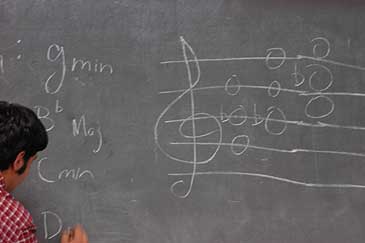
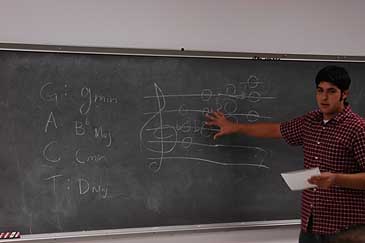
After receiving my DNA strand, through research
I came to understand that it was a gene found in nitrogen fixation.
This gene itself points to the heart of the biotechnology debate:
although we seem to control everything around us, in fact we are
tied to the very essentials that created us, and always will be.
This is such a departure from the common notion that humans dominate
the world and therefore should be able to manipulate it, that I
decided to make this the central concept in my piece.
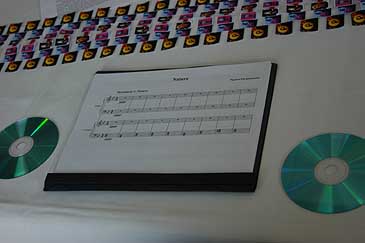
The first movement called “Nature”
was an original composition which attempts to show the harmony that
can and once existed between nature (represented by the DNA chords)
and society (represented as my original composition). As can be
heard, the ‘society’ works and in facts coexists with
nature, represented by the chords harmoniously existing with the
music being played.
The second movement entitled “creation”
is an attempt to aurally demonstrate biotechnology and the resulting
society if our attempts at controlling genes go too far. Listeners
should hear common themes twisted, juxtaposed and modulated –
much like the genes themselves. The result is a disturbing mix of
different styles of pieces, incoherently existing within one melodic
idea. These themes are analogous to DNA of different organisms –
much like the music is from different styles and different eras.
Throughout the piece, the DNA chords increase in volume, seemingly
fighting the progressing ‘society’. As times passes,
the nature begins to fight society as society has strayed too far
from nature. As a result, both society and nature are in disarray.
As the piece climaxes, it reaches a supposed death with the theme
from Beethoven’s 5th Symphony. Ironically, the final phrase
is a look into a perhaps better future, were both exist together
– an inherent reference to the first movement and to the beginning
of the second movement.
On another level higher level, the idea
of creation comes into play. By playing music over chords from DNA,
from “Nature” I am attempting to show that these aspects
are one and the same – that our notion of music is derived
from nature, as it has existed in nature from the beginning of time
– through DNA. “Creation” itself is an attempt
to show our society as music played over nature, and the subsequent
result when society forgets that nature is a force as well –
much like we have forgotten the need for nature in order to get
our needed amounts of nitrogen (through the DNA which is playing).
By incor-porating the idea of “Nature and Creation”,
I encourage the listener to question our role in society, and also
question the role of biotechnology as “Creator” or perhaps
just another force of “Nature”.
Materials: I worked with
the program Finale 2003 to compose the music.
The six other pieces came from selections from:
“The Entertainer” Scott Joplin
“Humoreske” A. Dvorak
“Turkish March” L.v.Beethoven
“Arabesque” C. Debussy
Piano Sonata op.27 no. 2 “Moonlight” L.v.Beethoven
The Fifth Symphony L.v.Beethoven |