|
Summary/Statement:
Our eyes are remarkable sensory organs capable of distinguishing
light, depth, and color. The ability to interpret different types
of color (red, green, and blue) is processed by color sensitive
cones in our eyes. Two specific cone pigments, red and green, have
been studied immensely over the years due to the common occurrence
of a condition known as red-green colorblindnes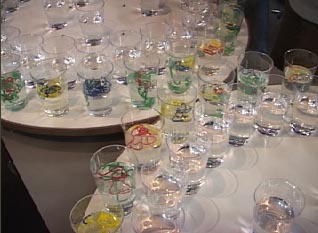 s.
Red-green colorblindness is an X-linked disease, the product of
incomplete crossing over of our X chromosome. Essentially, the genes
which encode for the red and green cone pigments in our eyes get
mixed up and misplaced, leaving individuals either more sensitive
to green or more sensitive to red color. "Color Blind" is an adaptation
of the genetic sequence for the red cone pigment (red opsin). The
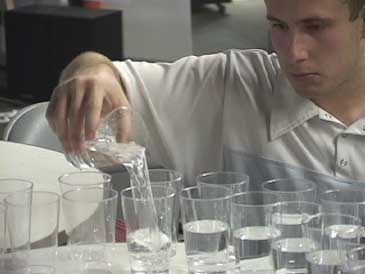
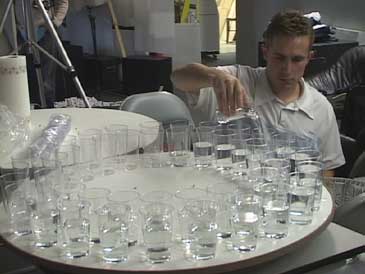
outer most ring of cups on each turntable represent a complementary
strand of cDNA for that pigment. As you spin the turntables, you
will notice that each cup--the equivalent of a three-nucleotide
codon--lines up with a complementary cup on the opposing turntable.
These complementary cups are very specific to each other, and will
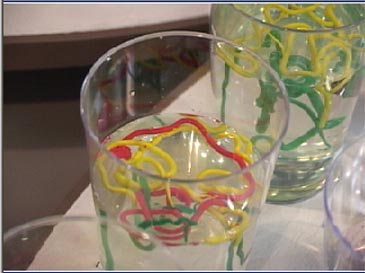
line up indefinitely, much like a real DNA strand. The inner ring
of cups represent a mutation in the original cDNA sequence. By comparing
the mutated inner code to the original outer code, one can see how
slight defects dramatically affect the properties of the gene. These
mutations are analogous to the possible mutations seen in faulty
red cone pigment genes of individuals with red-green colorblindness. s.
Red-green colorblindness is an X-linked disease, the product of
incomplete crossing over of our X chromosome. Essentially, the genes
which encode for the red and green cone pigments in our eyes get
mixed up and misplaced, leaving individuals either more sensitive
to green or more sensitive to red color. "Color Blind" is an adaptation
of the genetic sequence for the red cone pigment (red opsin). The
outer most ring of cups on each turntable represent a complementary
strand of cDNA for that pigment. As you spin the turntables, you
will notice that each cup--the equivalent of a three-nucleotide
codon--lines up with a complementary cup on the opposing turntable.
These complementary cups are very specific to each other, and will
line up indefinitely, much like a real DNA strand. The inner ring
of cups represent a mutation in the original cDNA sequence. By comparing
the mutated inner code to the original outer code, one can see how
slight defects dramatically affect the properties of the gene. These
mutations are analogous to the possible mutations seen in faulty
red cone pigment genes of individuals with red-green colorblindness.
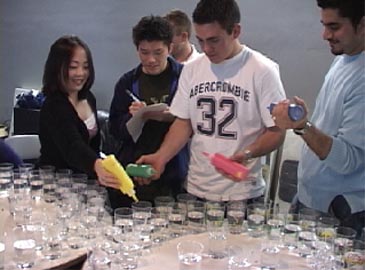
Special
thanks to all Genetics and Culture participants who helped me out
with the production of my piece.
|