| Statement:
For my genetic artwork, I explored the idea
of the mosaic and how it relates to DNA. When I think of a mosaic,
I think of different colors and shapes being combined to create
a beautiful picture. The raw materials alone, stones and glue, do
not have any type of meaning or aesthetic value. But it is when
the stones are placed together to create some sort of pattern do
we consider it to be art. I tried to relate this idea to DNA and
how it shapes who and what we are. Chemical bases are meaningless
unless they are placed together in a certain arrangement, or pattern,
to create the blue-print of life. I wanted to create a genetic mosaic
because in reality we are all mosaics. We all have internal and
external differences partly because of the differences in each of
our DNA.
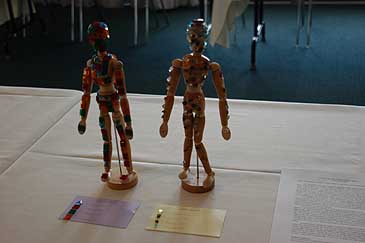
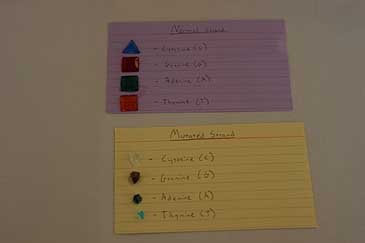
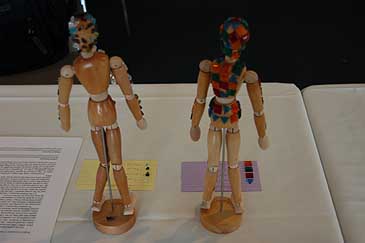
To construct my project, I used two wooden
figures, one containing the normal strand and one containing the
mutated one. I pasted different colored stones, each representing
a different base, on each of the figures. I thought of the wooden
figures as representing human beings, which I think can be considered
a canvas for an artist, DNA. DNA is an artist because it contains
the blue-print for the human form, just as an artist has the form
and ideas for his/her artwork.
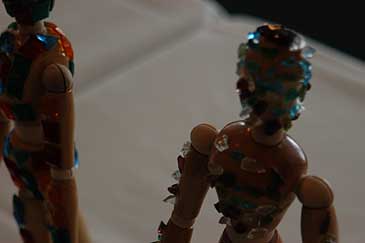
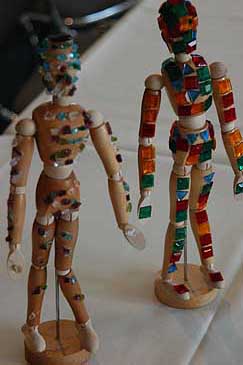
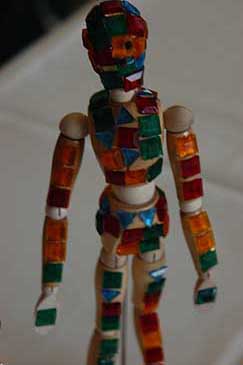
For the mutated sequence, I used jagged
stones instead of the smooth stones I used for the normal sequence.
I did this because there are no two jagged stones that are exactly
the same, just as in real life there are no two people that are
exactly the same. Since mutations are very common in our DNA, I
wanted the mutated strand to reflect real life. The normal sequence
is not true of real life DNA because it contains no mutations. That
is why the normal sequence is made of stones which are identical
to each other (except their color). I also glued the mutated sequence’s
bases in such a way that it resembles the helix of a strand of DNA.
I did this because I wanted the mutated strand to resemble DNA more
than the normal strand, since the mutated strand is more like real
life DNA.
In conclusion, I think that using a real
DNA sequence is an interesting way to create art. That is because
the genetic code makes us who we are and even gives us the artistic
capability to create art. The genetic code and art seem to go hand
in hand because we wouldn’t be able to create art without
the ability to move our bodies, something that is coded for in our
DNA. I found the idea of working with a mosaic to be interesting
because there are many symbols and ideas that go along with mosaics.
I tried to relate those ideas to DNA and create a project that is
not only aesthetic but also imaginative and original. |