| Statement:
Picture yourself in a time where genetic
screening is as common as a blood test, and the resulting profile
dictates to everyone at a glance the kind of person you are. Information
about your health status, physical traits, and how smart you can
become, would not be a mystery to anyone. It’s almost like
making an unintelligent remark when you first meet someone, and
giving a first impression of stupidity; your genetic makeup could
change the way people behave towards you before they got to know
you or your full capabilities. Also, if this happened often enough,
it might even induce a self-fulfilling prophecy effect.
Your clothing can supposedly reveal a lot
about your personality. As a result, people often form expectations
based on how you look before they even meet you. From the DNA sequence
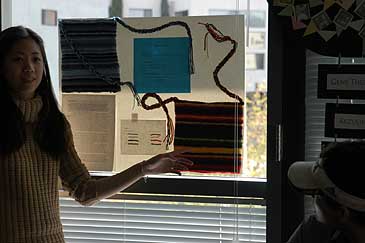
I was given, I crocheted two hats; articles of clothing that I believe
are usually noticed before anything else when they are worn. For
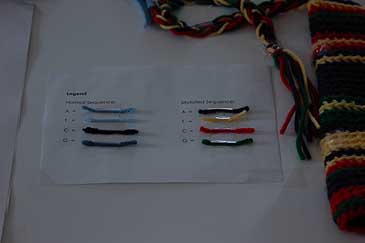
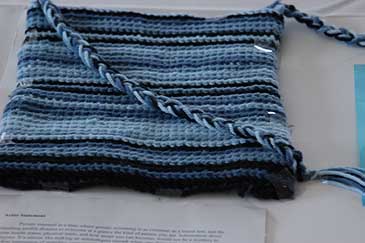
the first hat, I used black yarn to represent the nitrogenous base
cytosine, dark blue to represent guanine, regular blue for adenine,
and light blue for thymine. There isn’t much significance
behind these colors, except that blue is easy on the eyes and doesn’t
call for much attention. These ordinary colors look pleasing together,
and give a sense of simplicity and normality. They were used in
order to contrast the bright eye-catching colors of yarn used to
make the hat that represents the mutated sequence. The first 40
base pairs of the sequence I was given were used to determine the
sequence of colors in the hat, starting with the rim and finishing
at the top where the ends tie off. Using a half stitch, double loop
method of crochet, I let each row stand for one base pair, and knitted
that row using the color that stood for the particular base pair.
For instance, since the first four base pairs were C, G, C, and
C in that order, the first four rows of the non-mutated hat would
be black, dark blue, black, and black.
In the mutated version of the hat, I used
red yarn to stand for C, green yarn for G, purple yarn for A, and
yellow for T. There are more representations in this color selection
than before. For instance, complimentary colors were used for C
with G and A with T, since this is the way the base pairs bond.
In a color wheel, green is across from red and yellow is across
from violet. I decided on deletion for the kind of mutation to express.
I deleted five base pairs so the total number of rows in this hat
is less than the other one. There are thirty-five rows instead of
forty. Also, the five deleted bases were located relatively close
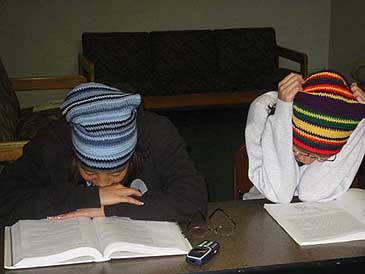
to each other. The result appeared as a broad purple stripe running
across the middle of the mutated hat.
If everyone had to wear their DNA sequence
out in the open on their heads, imagine the experiences of someone
who bore an abnormal violet stripe across their forehead for the
rest of the world to see. Mutations like this would be easy to recognize
since people with normal sequences would be very familiar with what
it should look like. Someone with a “weird” sequence
might have to endure prejudices against their less-fortunate gene
sequences. The colors of the mutated hat are also hard to miss.
No one would think twice about a person wearing an ordinary blue
and black hat, but a handful would stop to look at a red, green,
yellow, and purple striped hat.
Overall, I liked the way this project turned
out. If there was one thing I could go back and change, I might
have selected a more meaningful number of base pairs to use. Instead
of forty rows (picked only because it was easy to count and keep
track of base pairs by fives) I might have picked a number divisible
by three, since every three base pairs in the sequence completes
a codon. The hat was stitched inside-out because the texture of
each row seemed more DNA-like this way. Each row has a center ridge
and the stitches surrounding each ridge “bond” well
with the rows above and below it.
Finally, the tassels added to each corner
of the hat were made by braiding all four colors of yarn. The harmony
of colors created by this braid is spawned from a random intertwining
of the four bases used to build the entire hat. It is just like
the genetic makeup of an individual. Each time the strands are braided,
the colorful outcome is different. Each time a couple has children,
(unless they are twins) the children will come out slightly different
and unique.
Every stitch holds a part of the hat together,
the same way every A, C, T and G says something meaningful in the
genomic sequence. The braided tassels tie underneath the chin, and
pull together the entire hat. It is the final touch in unifying
all the strings as a functioning entity. |