| Statement:
Can you tell which DNA sequence is the “normal”
one and which is the mutated? Mutations arise spontaneously at a
very slow rate and mostly occur in the introns, or “junk”
DNA. It is notably rare for a mutation to occur in the coding region
(exons) of an organism’s DNA. And if that does occur, there
are mechanisms that reduce the chances of it becoming a problem.
For example, there are 64 different combinations that an amino acid
can take on, but only 20 amino acids, so that mistakes can be accounted
for and more than one combination will still have the same result.
Also, during DNA replication, the mechanism tries to “fix”
certain mistakes that arise due to factors like mutations.
Knowing all of this, I looked around and asked myself, “What’s
all the fuss about mutations?” There are movies and cartoons
that thrive on the power of mutations to change an individual. Teenage
Mutant Ninja Turtles and X-Men are examples of this mutant craze.
They both feature good and evil characters that have been mutated
to possess out of the ordinary powers. Moreover, deleterious mutations
are focused on by the scientific society that is frantically searching
for ways to “fix” them. So, the fuss is about the possibility
of the next level of human evolution and to be able to fix harmful
mutations … and, in my opinion, that is a logical way of thinking.
Accordingly, all the excitement about mutations
spread to artists. Many artistes create genomic works of art that
represent DNA and its relevance to us. Many feature works that play
upon the differences of normal and mutated DNA. These differences
are exaggerated because of their perceived effects. Normal DNA is
created to look heavenly, while mutated DNA looks very different
and, much of the time, darker. Even when my classmates and I were
sharing ideas on how to represent two sequences of DNA, most of
them saw fit to make the mutated DNA “funky” and “unusual.”
I have a different view. I do not believe
that looking the reverse of the norm should represent mutated DNA.
We already learned that mutations are rare, many go unnoticed, and
there are mechanisms in the body that try to account for them. Furthermore,
real-life mutations do not considerably change the shape or appearance
of DNA. They simply change, delete, invert or substitute certain
base pairs. Thus, I do not consider “normal” DNA and
mutated DNA to be visually divergent. This thought influenced my
art work.
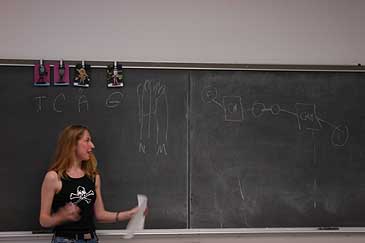
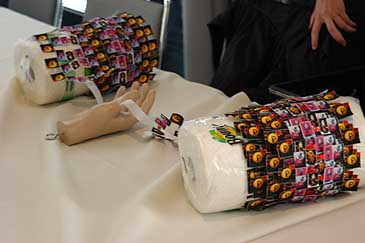
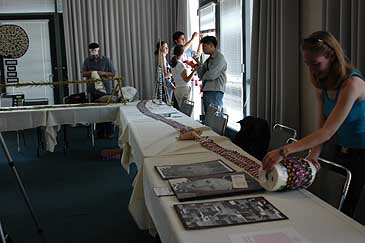
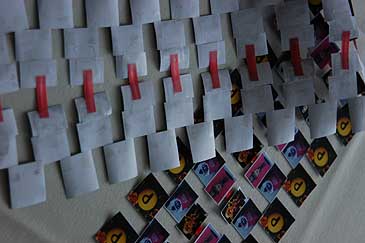
The work consists of two media: visual and
audio. In the visual piece, I reconstructed 100 base pairs of an
Ammonifex Degensii sequence – one “normal” and
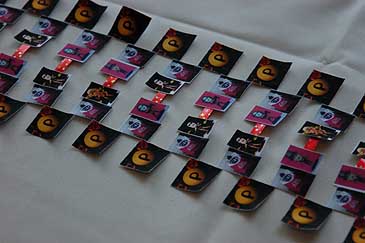
one mutated. I represented the base pairs with pictures of Rocky
Horror Picture Show characters. This is symbolic (well, in my mind
because I’m such a fan) because these characters were open
minded and learned to accept all types of diversity. So, if mutations
occur at random, the sequence still looks “right” because
all of the characters do each other in the movie. My mutated DNA
included point mutations, deletions, and insertions. It is highly
unlikely that all three will occur in one line of 100 bases, but
because the sequences still look the same and are equally aesthetically
pleasing, I show that the societal connotations of mutations should
not influence how they are portrayed.
The second aspect of my piece is an audio
component that enables the viewer to hear the sequences that they
see through molecular music that I synthesized on the computer.
The two melodies sounded very alike, actually, too alike. I had
to struggle to make the two sound unalike by adding different background
melodies, changing the tempos, and changing musical instruments.
It is apparent to the listener that the two sequences sound very
different only due to these changes and not the actual mutations.
Working with a specified sequence was both
restrictive and moving. It was restrictive mainly because the proportions
of the visual component got much longer than I wanted in the first
place, it too long to make, and the molecular music (no matter how
much I tried to liven it up) sounds boring. Then again, the long
visual component really inspired me. It turned my conceptual knowledge
of DNA length into a physical form that I related to, and thus really
enabled me to envision, for the first time, this massive quantity.
The size evokes a feeling of awe, and is a truly cool thing to look
at.
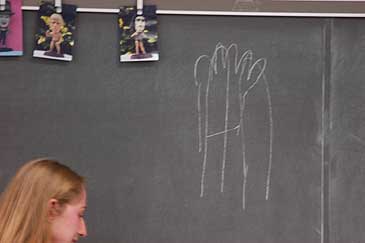
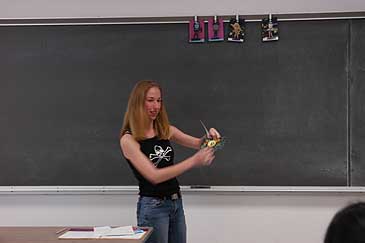
The work was constructed in two different
media. For the visual piece, I took photographs of Rocky Horror
Picture Show dolls, scanned them, edited them, and finally printed
them with a 1 inch length dimension. I also took a picture of a
C&H sugar pack to represent the sugar and a yellow rubber ball
with a “P” to symbolize a phosphate. I attached all
of these pieces with tape in the way that unraveled DNA looks. I
then built the complementary strand using the DNA base pairing rules
and attached the two strands with a red ribbon. For the audio component,
I assigned a note for each of the bases and created molecular music
on Sonar. To make the two melodies differ, I deliberately changed
the tempo, instruments, and accompaniments. |