Title:"DNA
in Bloom"
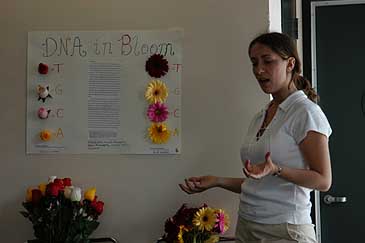
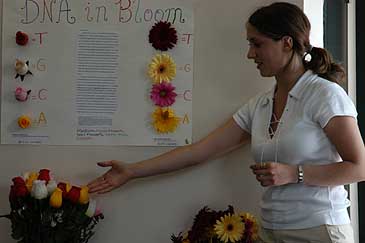
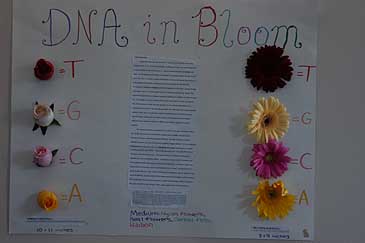
Medium and Dimensions:
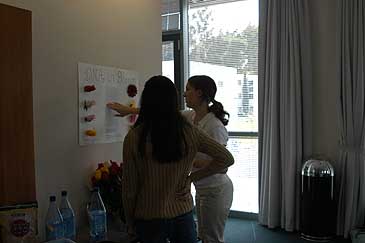
Nylon flowers, Gerber Daises, Dental floss,
Ribbon
Dimensions: 10x11 inch (fake), 8x9 inch (real)
Legend: T=Red flower, G=Cream flower, C=Pink flower, A=Yellow
flower
|
| Statement:
It seems the more we learn about DNA,
the more we forget about the other building blocks of life. Genes,
increasingly, are being seen as the sole determining factor in who
and what we are, as the nature vs. nurture question becomes increasingly
one-sided. As a burgeoning psychologist who believes our genetic
material will only ever be part of the story, I wanted to explore
the interplay of nature and nurture in my artwork. I contemplated
what medium would best express the potential of both DNA and environment
in shaping an individual and found inspiration in the classic “tomato
thought experiment” which I had been taught in both my biology
and psychology classes. The experiment requires that you imagine
a gardener grabbing two handfuls of seeds from one bag. One handful
is spread in a field well-nurtured, given plenty of water and fertilizer.
The other is placed in a field, and then ignored--its environment
could definitely be considered impoverished. The experiment predicts
that while both field’s plants will show variation within
their own population (based on genetic causes), there will be greater
variation when comparing the two fields, because of the difference
in environment. Different living conditions will lead to different
physiologies, regardless of genetic similarity.
This famous experiment inspired me to use
plants in my piece, and because this is art I decided to use the
most aesthetically pleasing plants available, namely flowers. However
this began presenting a logistical difficulty. We were required
to use one hundred base pairs, but using one hundred live flowers
seemed difficult. As I was thinking of how to circumvent the problem
of using real flowers I began thinking about another troubling perception
about DNA. There is the assumption that unmutated DNA is both free
from error, and the status quo. Diseases are blamed on mutations,
allowing the diseased to be seen as somehow inferior. In actuality,
everyone’s DNA is mutated, and most mutations are harmless
(and occasionally even beneficial). I wanted to explore the misperceptions
of mutation, and so I decided that for my “normal” (unmutated)
DNA I would use fake flowers. They would be flawless and homogenous,
but also artificial. They would be immortal, as many people feel
the human species can someday be with the aid of DNA technology.
For my mutated sequence I would use real flowers, which would have
flaws and variation but also a beauty which vastly surpassed that
of the fake flowers. |