| Statement:
In approaching a critique of genes through
art, I chose to express my dissatisfaction with the popular notion
that our genes determine everything about us; nuances of humour,
propensity to anger, and susceptibility to disease are thought by
many to be directly related to the billions of strands of coded
genetic information that we posses. I however believe that this
is untrue: two people, twins or clones for example, with the same
set of genes can emerge as completely different people, unique as
dictated by their interaction with the world about them.
Language is a perfect metaphor though which
to express this idea. Though speech is bound by rules and structures,
individual and regional patterns of speech can differ greatly, and
the interactions of these speakers mutate the language through exchange
of slang. Languages are constantly evolving, and it is of interest
to note that the same mutations in language that occur as a result
of this evolution are frowned upon by those who chose to reject
them in favour of the established ‘pure’ language form,
just as many believe that mutations, however numerous or benign,
are somehow harmful and to be avoided or corrected.
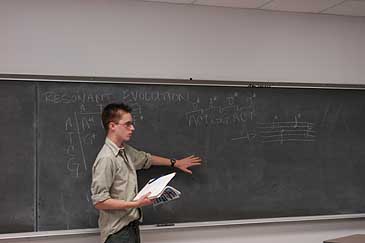
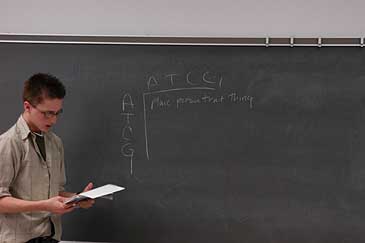
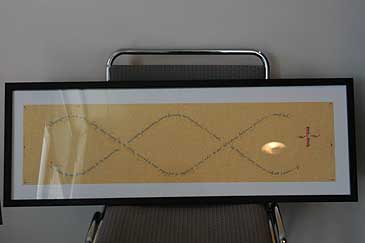
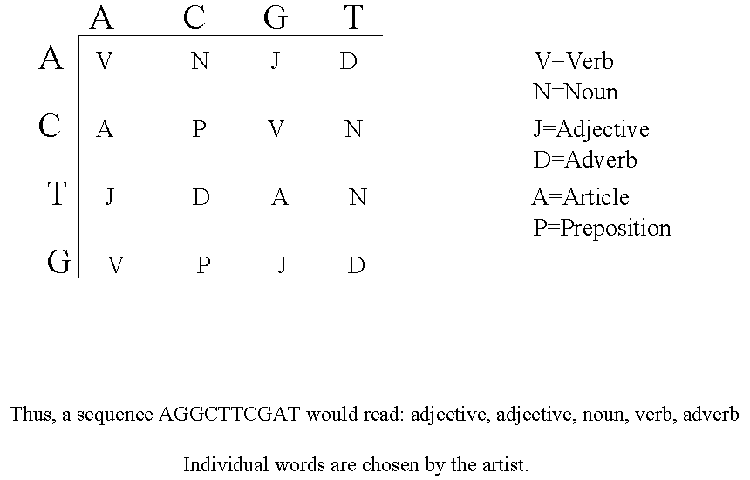
I decided to use the structure of my Ammonifex
Degensii fragment to determine the structure of the poems written
here: a CG pair results in a verb, etc. The grammar of the poems
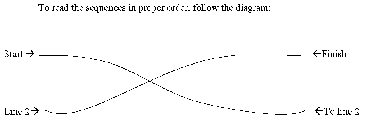
is determined by the order in which the bases fall, following the
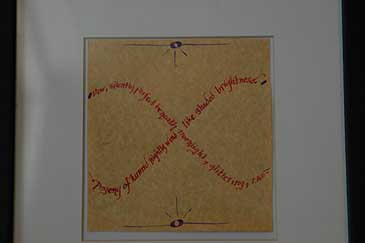
simple legend shown above. I used 50 bases for the first line of
the ‘original sequence’ poem; the second line corresponds
to the matching base pairs, resulting in a poem of two lines, 25
words each, that I chose to display in a double helix, reminiscent
of the DNA which determines their structure. The fragments below
follow the same pattern using 16 bases instead of 50 (for sake of
space), resulting in two fragment poems of 16 words each. One poem
is a clone of the original sequence, using the first 16 base pairs;
the second is a mutated fragment comprised of translocated codons
chosen at random.
I chose not to mark any of the poems to point
out several distinctions. The first is that none of the poems is
truly confined to its genetic code: though the structure of each
is pre-determined, the words are chosen at random by whim of the
artist, just as the expression of personality and experience in
each individual is a result of chance encounters and events entirely
unrelated to genes. Secondly, the ‘clone’ poem, though
an exact fragment of the original, is a wholly different piece,
almost completely distinguishable from the original. So many people
fear that armies of clones might arise as perfect copies of an individual,
or some hope that the unduly deceased can be somehow resurrected
through cloning, when in fact, the clone would most likely be nothing
like its host. Lastly, the ‘mutated’ poem is also indistinguishable
from the natural variation in the others, reflecting the fact that
most mutations are not in fact the cause of malfunctioning genes,
but are simple errors in code that give rise to evolution and diversity:
if every genome were to match exactly, how would physical characteristics
differ significantly enough to allow natural selection to occur?
Mutations are rarely the enemy, instead, they are simply nature’s
way of helping species to cope with their environments.
An observer of all three, without prior knowledge
of their codes, would be hard pressed to pick out each for what
it is, just as in populations, each individual is a mutation from
the next, or could be a twin to another, and yet it is rare that
one can detect any sign of such state. This forces observers of
the piece to examine their own perceptions of the importance of
the genome in determining self. |